
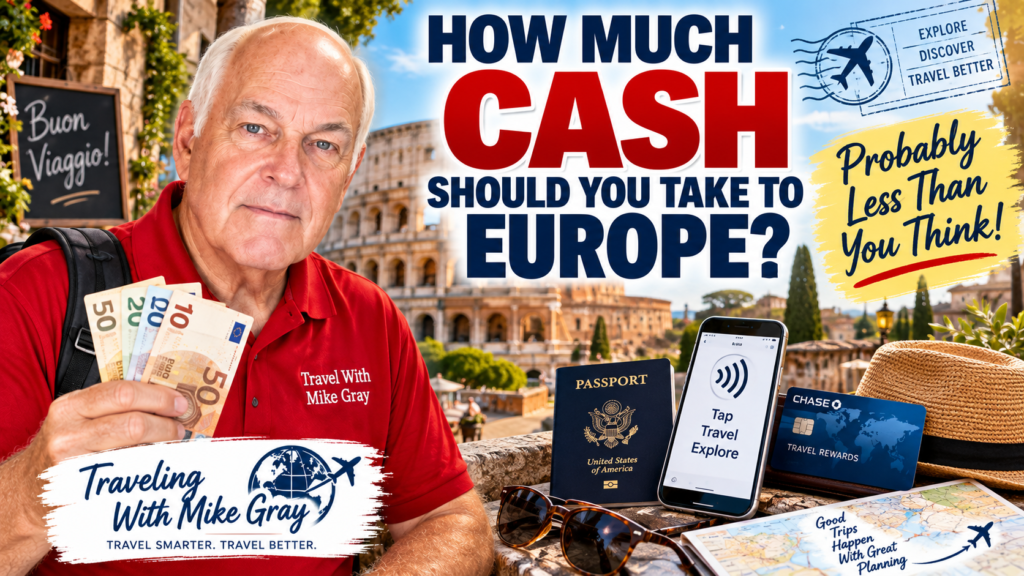
How Much Cash Should You Take to Europe? Probably Less Than You Think
You’re finally going to Europe.
The flights are booked. The hotels are reserved. Your passport is ready.
Then comes one of those questions that almost every first-time international traveler asks:
How much cash should I take with me?
Should you buy hundreds of euros before leaving home? Should you exchange dollars at the airport? Can you simply use a credit card?
For most travelers today, my advice is pretty simple:
You probably don’t need nearly as much cash as you think.
Cards and contactless payments are widely used in many European destinations, but carrying a modest amount of local currency is still smart.
Here’s how I would handle it.
Don’t Carry Your Entire Vacation Budget in Cash
Years ago, international travel often meant carrying traveler’s checks or a substantial amount of foreign currency.
Those days are largely behind us.
For many purchases, travelers can use a credit card, debit card or a mobile wallet such as Apple Pay or Google Pay.
That means there’s usually no reason to walk around Rome, Paris or London with a wallet stuffed with enough cash to finance your entire vacation.
Besides being inconvenient, carrying too much cash creates another problem:
If cash is lost or stolen, recovering it is usually impossible.
But Don’t Travel With Zero Cash Either
I’m a big believer in having a backup.
Even in places where cards are commonly accepted, you may encounter a small business, market, taxi, café, restroom or other situation where cash is useful.
Technology can also fail.
A card can be declined. A payment terminal can stop working. Your bank might flag an unusual transaction.
That’s why I’d still carry a modest amount of local currency.
Think of cash as your backup plan, not your primary payment method.
How Much Cash Would I Carry?
There isn’t one magic number because it depends on where you’re traveling and what you’re doing.
But for many travelers, I wouldn’t start a European vacation carrying thousands of dollars’ worth of foreign currency.
I’d rather have enough cash to comfortably handle smaller purchases and unexpected situations, then obtain more locally if necessary.
For example, having the equivalent of roughly $100 to $200 in local currency available can provide a useful cushion for many travelers.
That’s not a rule. It’s simply a reasonable starting point.
If you’re heading into rural areas, visiting cash-oriented markets or taking private transportation where cash is expected, you may want more.
If you’re spending four days in a major city and almost everything is prepaid, you may need very little.
Should You Buy Euros Before Leaving the United States?
You certainly can.
Some travelers like arriving with local currency already in their pocket, and there’s nothing wrong with that.
It can be reassuring to land in another country knowing you can immediately pay for a small purchase without searching for an ATM.
But I wouldn’t automatically exchange a large amount before leaving home.
Currency exchange services can include fees or less favorable exchange rates.
Convenience has a price.
If having 50 or 100 euros in your wallet makes you more comfortable when you land, that’s perfectly reasonable.
Just don’t assume you need to purchase your entire vacation’s spending money in advance.
ATMs Can Be Useful — But Pay Attention
An ATM can be one of the easiest ways to obtain local currency while traveling.
But not every ATM is equal.
Whenever possible, I prefer using an ATM associated with a recognizable bank rather than a standalone machine sitting in the middle of a heavily traveled tourist area.
Before your trip, check what your own bank charges for international ATM withdrawals.
There could be an ATM fee, a foreign transaction fee or both.
Knowing that beforehand prevents surprises.
Be Careful With Currency Conversion at ATMs and Stores
Here’s something travelers should understand before leaving home.
Sometimes an ATM or card terminal will ask whether you want the transaction processed in U.S. dollars rather than the local currency.
That may sound convenient.
But the conversion rate offered through what’s commonly called dynamic currency conversion may not be as favorable as allowing your card network or bank to perform the conversion.
When given the choice, I generally prefer paying in the local currency and letting my card issuer handle the conversion.
For example:
In Italy, pay in euros.
In Britain, pay in pounds.
Don’t choose dollars simply because the number looks familiar.
Check Your Credit Cards Before You Leave
Not all credit cards are equally good for international travel.
Before your vacation, find out whether your card charges a foreign transaction fee.
A card that adds a percentage to every international purchase can quietly increase the cost of your trip.
If you travel internationally with any regularity, a card with no foreign transaction fee can be very useful.
Also make sure you know your PIN if you’ll need one and have a backup payment method.
I wouldn’t travel internationally with only one card.
Don’t Keep Everything in the Same Place
This is one of those simple travel habits that can save a lot of trouble.
Don’t carry every credit card, debit card and dollar you have in the same wallet.
If that wallet disappears, you’ve lost everything at once.
I prefer having a primary payment method with me and keeping a backup card and some emergency money somewhere secure.
The idea is simple:
Never allow one lost wallet to become a financial emergency.
What About Tips?
Tipping customs vary considerably from one European country to another.
Don’t automatically assume that American tipping practices apply everywhere.
In some destinations, service may already be included. In others, leaving a small amount is customary.
This is one reason having a little cash can be handy.
Before traveling, learn the customs for the specific countries you’re visiting rather than relying on one rule for all of Europe.
My Simple Europe Money Strategy
I like to keep travel money uncomplicated.
For most trips, my basic approach would be:
- Carry a modest amount of local currency.
- Use a credit card with no foreign transaction fee for many larger purchases.
- Have a debit card available for ATM withdrawals.
- Pay in the local currency when given the choice.
- Keep a backup card separate from your primary wallet.
- Don’t carry more cash than you’d be comfortable losing.
That gives you several ways to pay without walking around with a small fortune in your pocket.
Travel Is Easier When You Know Before You Go
Little questions like money, tipping, transportation, passports and phone service can create a surprising amount of anxiety before an international trip.
But most of them become pretty simple once you understand your options.
That’s part of traveling smarter.
You don’t have to know everything.
You just need to know enough to avoid the mistakes that create unnecessary stress.
And then you can concentrate on the important things — enjoying that Italian dinner, seeing the sights you’ve dreamed about and wondering why you waited so long to go.
Planning a Trip to Europe?
Europe can be one of the most rewarding vacations you’ll ever take, but there are a lot of moving pieces — flights, hotels, transportation, tours, cruises and all the little details in between.
At Traveling With Mike Gray, I help travelers put those pieces together and make the planning process a little less overwhelming.
Whether you’re dreaming about Italy, a European river cruise, the Mediterranean or another destination, I’d be glad to help.
Travel smarter. Travel better.
Visit MikeGray.CruiseBrothers.com/cb to start planning your next vacation.
Leave a Comment